Understanding Ethical Manufacturing in the Canadian Apparel Industry

When you buy a garment or a fabric face covering, the finished item tells only part of its story. Ethical manufacturing also concerns the people who made it, the materials and suppliers involved, and how clearly a brand can explain its production choices.
In Canada’s apparel industry, locally made products can make some parts of production easier to see, but a Canadian label alone does not prove fair labor or responsible sourcing. A useful assessment looks beyond where an item was sewn and asks how the full process is managed.
What ethical manufacturing means in apparel
Ethical manufacturing means making apparel in ways that respect workers, consider the effects of material sourcing and production, and hold brands accountable for their claims. It covers labor practices, workplace conditions, purchasing decisions, and the information a company shares about its supply chain.
There is no single label that captures every part of an ethical product. One company may provide detailed information about sewing locations but know less about the origin of its fabric. Another may use lower-impact materials while offering little detail about workers’ conditions. It helps to assess a product across several connected areas:
- Labor: Are workers treated respectfully, paid for their work, and given reasonable conditions?
- Sourcing: Can the brand identify where its fabric, thread, elastic, and other components come from?
- Production: Does the company explain where cutting, sewing, finishing, and packing take place?
- Accountability: Can the brand answer questions, correct problems, and distinguish known facts from information it has not verified?
Ethical manufacturing is best understood as a practice rather than a permanent badge. A brand may have strong standards and still face gaps in its records or supplier oversight. Honest communication about those limits can be more meaningful than broad claims such as “100% ethical” with no supporting detail.
The people and processes behind a garment
A garment’s ethical profile depends on the people who make it and the decisions that shape their work. Fair labor practices and safe, respectful workplaces matter at every production stage, from fabric preparation to final stitching.
Garment workers may cut fabric, operate sewing machines, inspect finished pieces, or handle packing. Their working conditions are affected by practical business choices: production deadlines, order sizes, last-minute design changes, and the prices a brand agrees to pay. A rushed order or a price that leaves little room for labor can place pressure on workers, even when a company’s public values sound strong.
When evaluating a brand, look for concrete descriptions rather than promises alone. Useful details might include the country or city where sewing happens, whether production is handled by employees or an independent workshop, and how the company communicates expectations to its suppliers. A small Canadian maker may have direct contact with its sewing team, but small scale by itself does not confirm fair pay or safe conditions.
Ask how the brand handles concerns, too. Does it describe a way for workers or suppliers to raise issues? Does it review its arrangements when production changes? Shoppers may not be able to independently verify every answer, but a clear, specific response gives a better basis for comparison than a slogan.
Why transparency matters across the supply chain
Supply chain transparency helps shoppers understand where materials come from, where products are made, and what a brand can verify about its suppliers. It makes ethical claims easier to assess and gives companies a clearer basis for taking responsibility when details are missing or problems arise.
An apparel supply chain can include fiber producers, textile mills, fabric distributors, cutting rooms, sewing workshops, and finishing or packing operations. A brand may know its direct sewing partner but have limited information about the mill that produced the fabric. That distinction matters: production traceability often develops in stages, and a responsible company should not imply that it has complete knowledge when it does not.
Look for information at a level that can be checked, such as named production locations, descriptions of supplier relationships, and material details. For example, “sewn in Canada using imported cotton fabric” is more informative than a broad claim that a product is “locally made.” If a company cannot name a supplier for commercial reasons, it can still explain what it does know and how it monitors the relationship.
Transparency is not the same as proof that every practice is ethical. A detailed supplier list does not, by itself, establish fair working conditions. It does, however, help create accountability: brands can be asked to explain their standards, their verification methods, and the steps they take to address gaps. For Canadian businesses, the Government of Canada’s supply chain transparency resources provide background on public reporting and supply chain responsibilities.
What Canadian-made does—and doesn’t—tell you
Canadian-made tells you something about a product’s manufacturing location, but it does not automatically confirm fair labor, responsible sourcing, or full supply chain transparency. Local production can make some relationships easier to observe; it cannot answer every ethical question on its own.
When cutting and sewing happen in Canada, a brand may be able to communicate the workshop location or speak directly with the people producing an item. Shorter distances can also simplify visits and conversations. Those are potential advantages, not guarantees. A product sewn in Canada may still use imported fabric or components, and local production alone does not establish how workers are treated.
Likewise, products made outside Canada are not automatically unethical. The relevant questions concern the actual labor practices, sourcing, oversight, and disclosure involved. For shoppers, the most reliable approach is to treat origin as one useful data point in a wider assessment.
Check what the label means in practice. Does the brand say which steps occurred in Canada? Where did the fabric come from? Were finishing and packing done locally, or only the final sewing? Clear answers help distinguish a meaningful production description from a country-of-origin phrase that leaves important details unresolved.
Applying these principles to fabric masks and face coverings
Ethical manufacturing principles apply to fabric masks and face coverings just as they do to other apparel: assess the workers, materials, production locations, and traceability behind the item. For non-medical face coverings, keep the evaluation focused on how the product is made and described, not on unsupported health or protection claims.
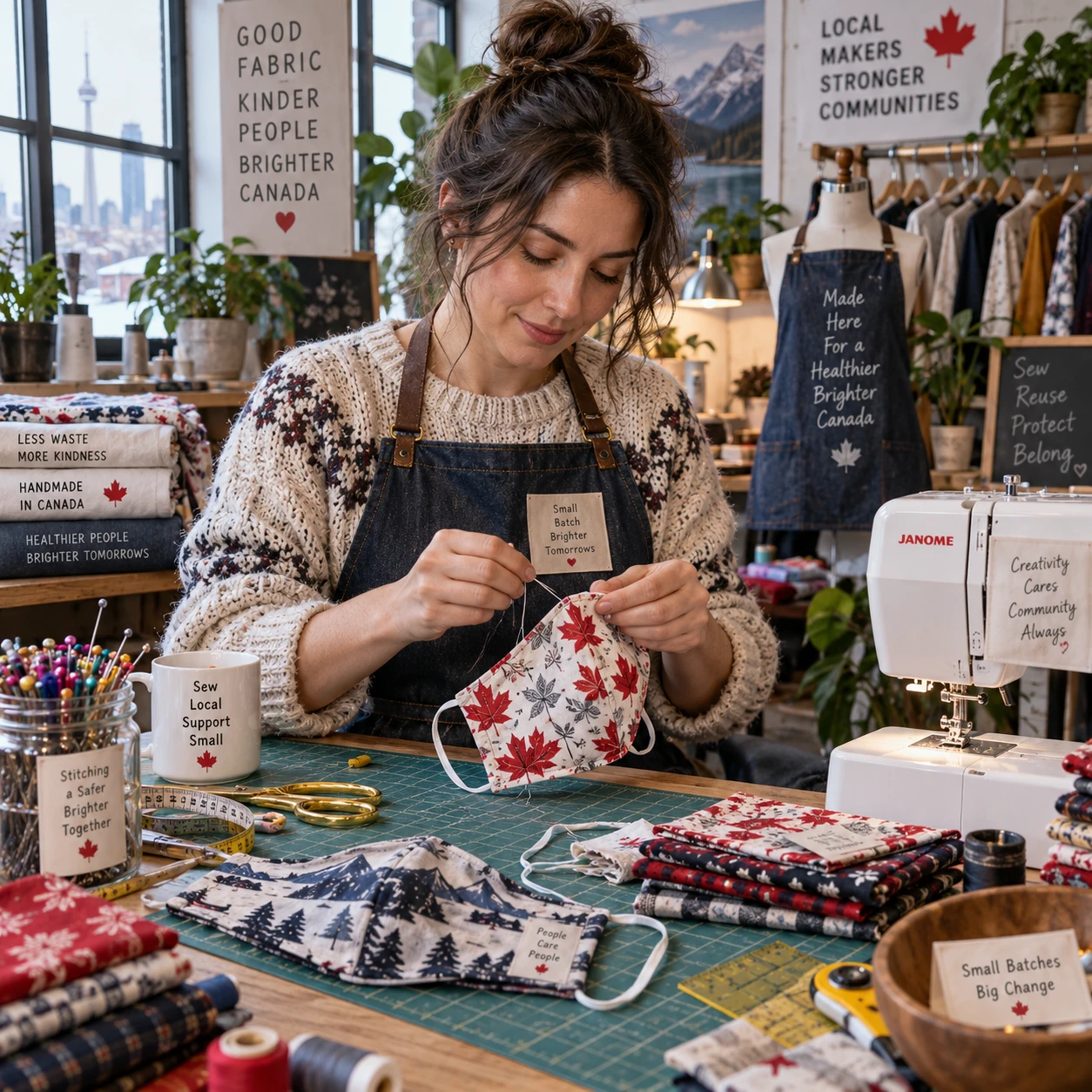
A fabric face covering may involve several components: outer and inner fabric, thread, elastic or ties, labels, and packaging. A small-batch maker might sew the coverings in a Canadian workshop while buying fabric or elastic from other suppliers. That arrangement can be perfectly straightforward if the brand explains it accurately.
When comparing products, look for details such as the fabric composition, care instructions, sewing location, and whether the brand makes the item itself or contracts production to another workshop. These facts help you understand the product and its manufacturing story. They do not establish medical suitability or a specific level of protection, so avoid treating ethical or sustainability language as a performance claim.
There can be trade-offs. Local, small-batch production may support closer communication and shorter production runs, while offering fewer options or a higher price than large-volume manufacturing. A higher price is not proof that workers were paid fairly, just as a lower price does not tell the whole story. Ask what the price and production information actually represent.
Questions to ask before choosing an ethically made product
To assess an ethically made apparel product, ask who made it, where each major production step happened, what materials it contains, and what the brand can verify. Specific, straightforward answers are more useful than a general ethical claim.
Use this checklist when choosing a fabric mask, face covering, or other apparel item:
- Who made the product? Does the brand identify its workshop, production partner, or manufacturing location?
- Which steps took place in Canada? Ask whether cutting, sewing, finishing, and packing were all local or only some of them.
- Where did the materials come from? Look for information about fabric and key components, not only the finished product’s origin.
- What does the brand say about worker treatment? Can it explain its expectations for suppliers and how it responds to concerns?
- What has been verified? Ask how the company knows the information it shares, and where it still has gaps.
- Are claims specific and consistent? Compare product descriptions, care labels, and company statements for clear, matching details.
Avoid relying on a single shortcut. Canadian-made, small-batch, and sustainable each describe different aspects of a product; none independently proves ethical manufacturing. If a brand cannot answer every question, consider whether it is candid about what it knows and whether it is working to improve traceability.
For a fabric face covering, a useful final check is simple: can you understand where it was sewn, what it is made from, and what the brand does and does not claim? That combination of clear information and realistic limits gives shoppers a stronger basis for choosing apparel that aligns with their values.